

06
Account Rules Builder
Design Challenge
Create an experience allowing clients to configure a set of rules that govern the legal combinations of segment values that can be combined to create accounts.
My Role
UX/UI Design
Prototyping
The Team
1 Product Manager
10 Software Engineers
1 Product Analyst
1 UX Researcher
1 Front End Developer
Intro
The General Ledger is a record-keeping system that tracks each financial transaction taking place in a town, city or school district. It allows users to manage finances and provide clear insight into the organization’s financial health (like a massive, complex checkbook).
At Tyler Tech, the General Ledger application suite is considered to be the “backbone” of all products, and the UX/UI hasn’t changed in nearly 30 years. As the lead designer on this initiative, I was tasked with rethinking the information architecture, designing new product features, and creating a more consumable, user-friendly product.
This was probably the most challenging piece of the General Ledger project to design for. The process is rather long and complicated, so I’ll show the final, coded design first, then step through the process.
The Solution
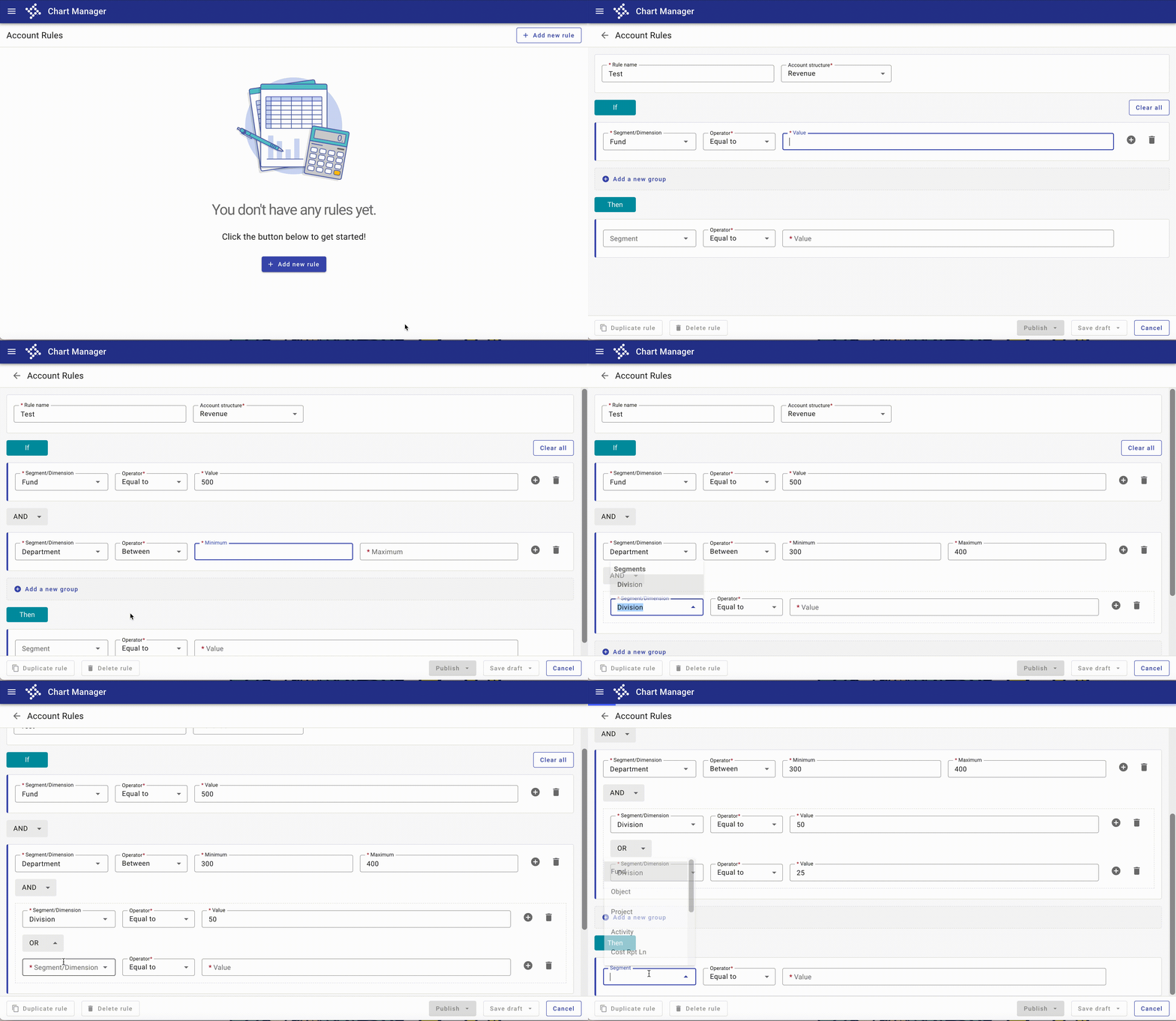
Discovery
Before I could begin any design work, I needed a deeper understanding of our targeted users, GL accounts, and how users interact with those accounts. I sat through many workshops and demos with our Product Analyst to build my foundational knowledge, and also sat in on product strategy meetings.
I learned accounts are made up of a string of numbers called segments that provide the “who” and “what” tied to a financial transaction. I also learned the purpose of the Rule Builder would be to allow the creation of accounts with legitimate (legal) segment combinations while preventing the creation of bogus (illegal) combinations.
Below is an example of both a legal and illegal combination of segments that form an account:
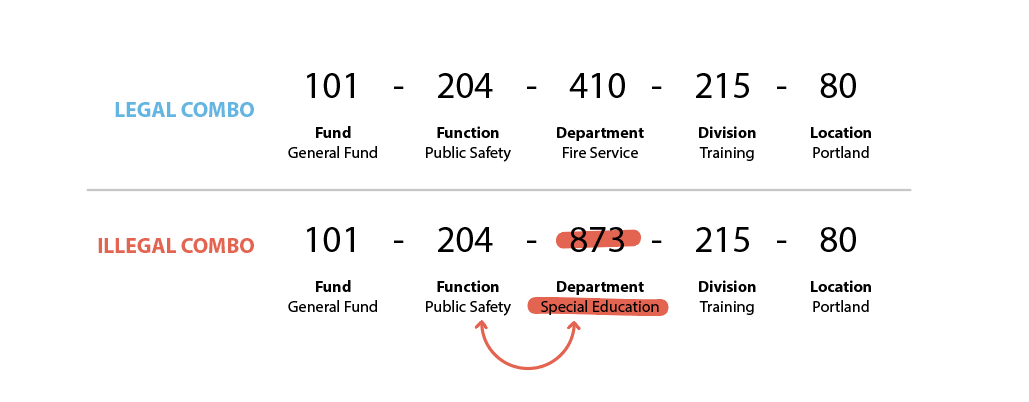
The Rule Builder will prevent the creation of illegal segment combinations
The legal combination is showing us that any cost associated with Fire Department training in the City of Portland will be recorded as Account 101-204-410-215-80. The second combination is considered illegal because it has the Department code for Special Education placed in a string of segments pertaining to the Public Safety sector.
If you’re with me so far, you’re doing great!
Personas who will be using the Rules Builder:
Note: The personas were developed in advance by the Product Strategy team


Ann, Finance Director
Day to day work
A typical day for Ann consists largely of meetings. She reports directly to the town administrator and is responsible for the general fiscal health of the town by recommending and establishing fiscal policy.
She oversees the daily operations, strategies, and performance objectives for overall financial management (can include other areas such as budgeting, payroll, receivables, payables, billing, grants, purchasing, etc.).
She’s responsible for adhering to Federal, state, and local reporting requirements. She runs year end activities and oversees audits for the town. Audits are completed every year by an independent audit company but she ensures that the results of the audit are published and visible by the correct parties.
Goals
• Ensure transparency
• Communicate correctly and effectively with stakeholders
• Ensure day to day processes run smoothly
• Stay cognizant of high-level financial measures and budget concerns
• Provide sound recommendations and guidance for financial strategy
• Create her organization’s Chart of Accounts and system rules
James, Assistant Finance Director
Day to day work
James reports directly to the Finance Director, but is often contacted by senior accountants with questions about how to do things. Highly responsible and detail oriented, James ensures proper authorization and documentation for disbursements and other transactions.
James is spends his time on the dashboard, monitoring budgets, purchasing and grants, but is proficient in all aspects of the financial software. He loves the high level view, but also the ability to dive into the granular details
James is a reports whiz. He prefers to spend his time in the reporting software over the nitty gritty of posting transactions and reconciliations. He’s even created a number of custom reports.
Goals
•Assist Ann with her day-to-day responsibilities
• Generate accurate reports efficiently and effectively
• Establish and streamline organization processes
• Stay up to date on GAAP standards
• Assist in creating the organization’s Chart of Accounts
Ideation
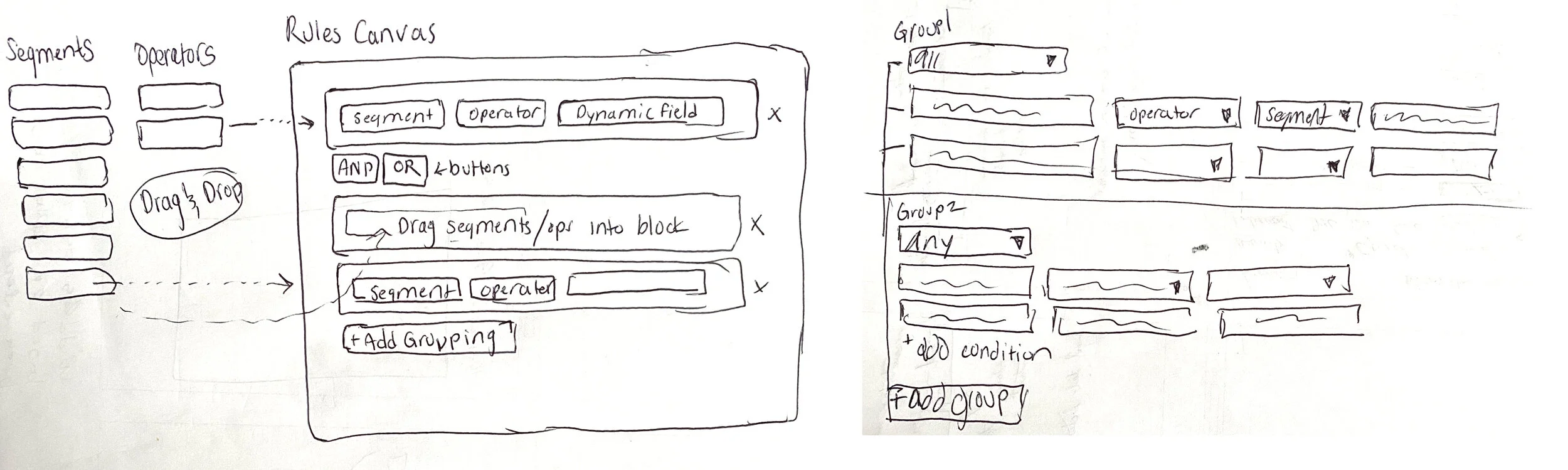
Once I understood the content, our users and the end goal, I asked the product team to join me in a sketching session. I knew the design ask was challenging, so I thought it would be beneficial to do this exercise with some true Boolean Logic experts. Though the sketches were tough to decipher, the presentation of their concepts and subsequent conversations were pure gold. My creative wheels were turning.
Sketching samples from the dev team
After the sketching activity, I went back and turned some of the ideas into fairly primitive designs. Here is an example:
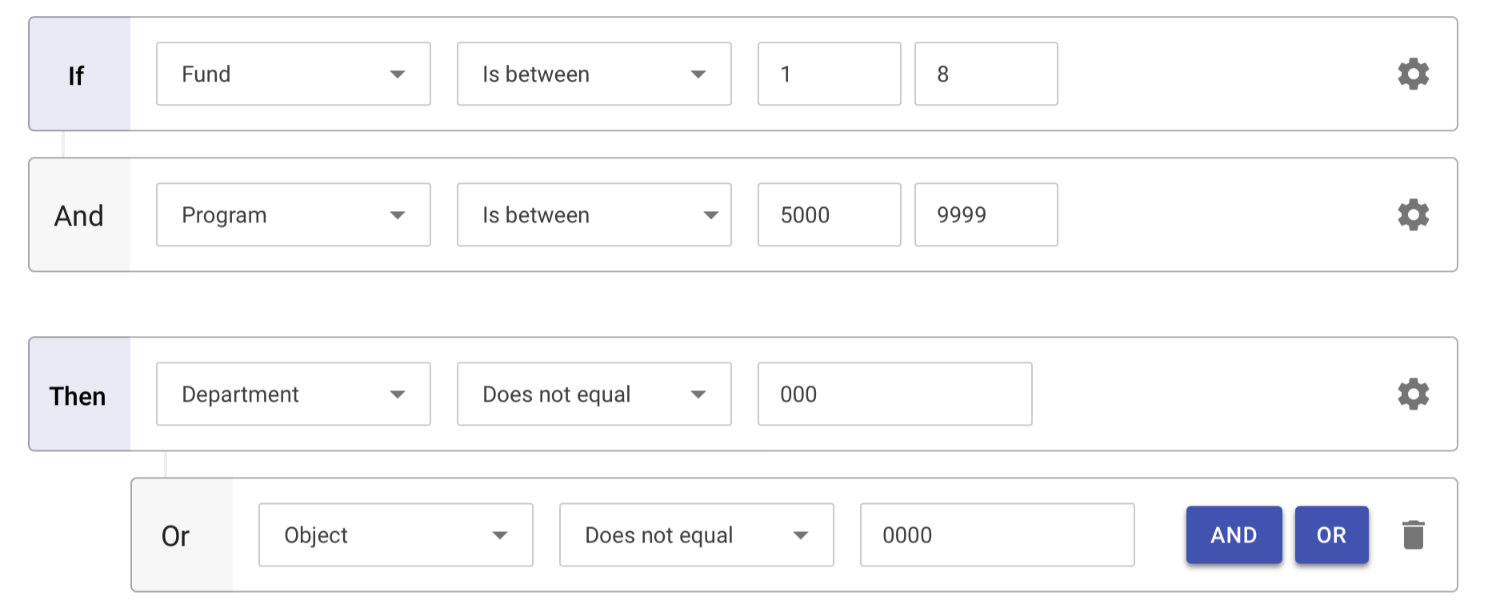
It was a good start, but as I reviewed designs with the team, the Product Manager emphasized the need to build an experience that could handle simplistic rules as well as extremely complex, Boolean Logic-type ones. I asked him to give me an example of a more complex rule, and this is what he gave me:
IF Fund Type equals G
AND (Fund is between 400 and 600 OR (Fund is between 100 and 300 OR Fund Class equals blank OR Department equals 999 OR Department equals 990))
AND Program begins with 5
—
THEN Object begins with 3
Given that I spent years teaching math, the large parenthetical rule didn’t intimidate me. Still, I created a more graphical representation of this rule as I still worked to wrap my head around what we were trying to achieve.
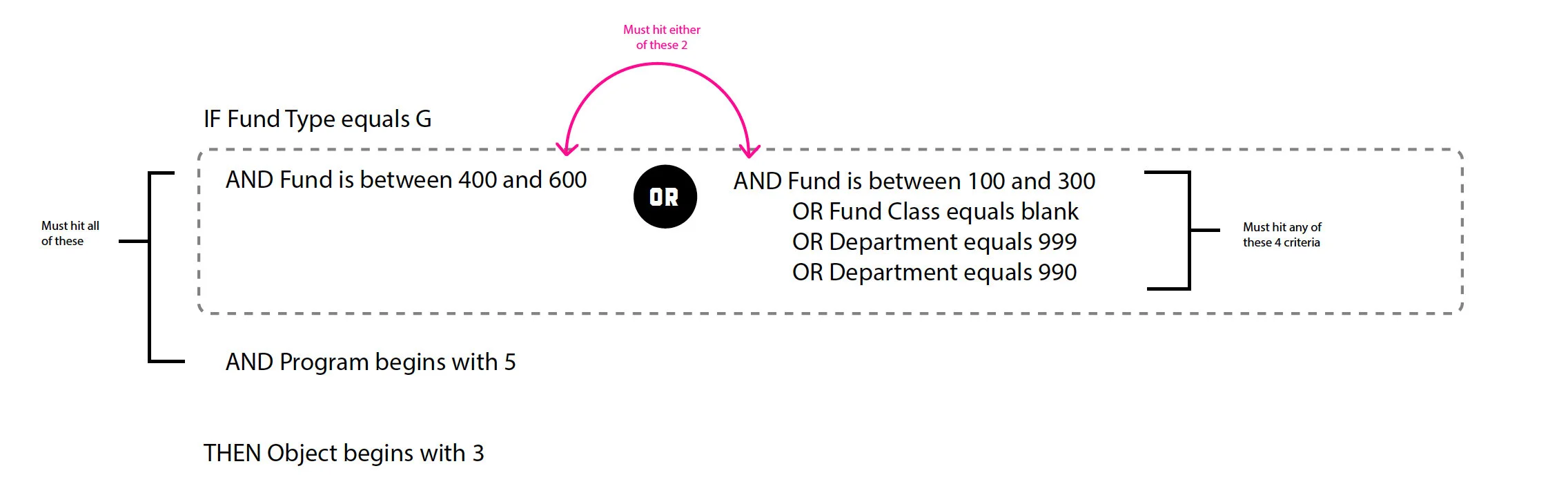
Cool. I made a neat graphic, but it still wasn’t totally clicking for me, and that’s because the language and numbers in the example felt arbitrary. After all, I don’t have a finance background. So in an effort to fully grasp the concept, I created my own complex rule around something I did understand - Animal Classification.
Here is the rule I created:
IF Animal has vertebrae
AND (Animal is cold-blooded OR (Animal has lungs AND (Animal has scales OR scrutes OR carapace)))
AND Animal produces hard-shelled eggs
—
THEN Animal is reptile
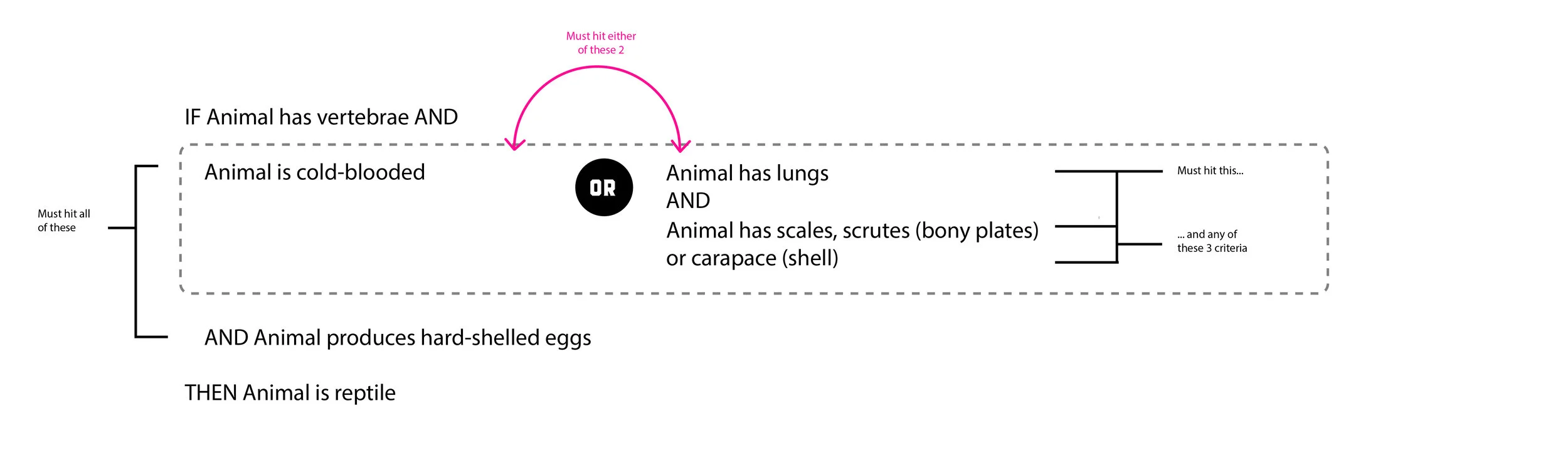
Incidentally, this reptile rule would also prove effective in helping our UX Researcher understand the Rules Builder :)
Now that the content was far more relatable, the design came much easier.
Design + Prototype
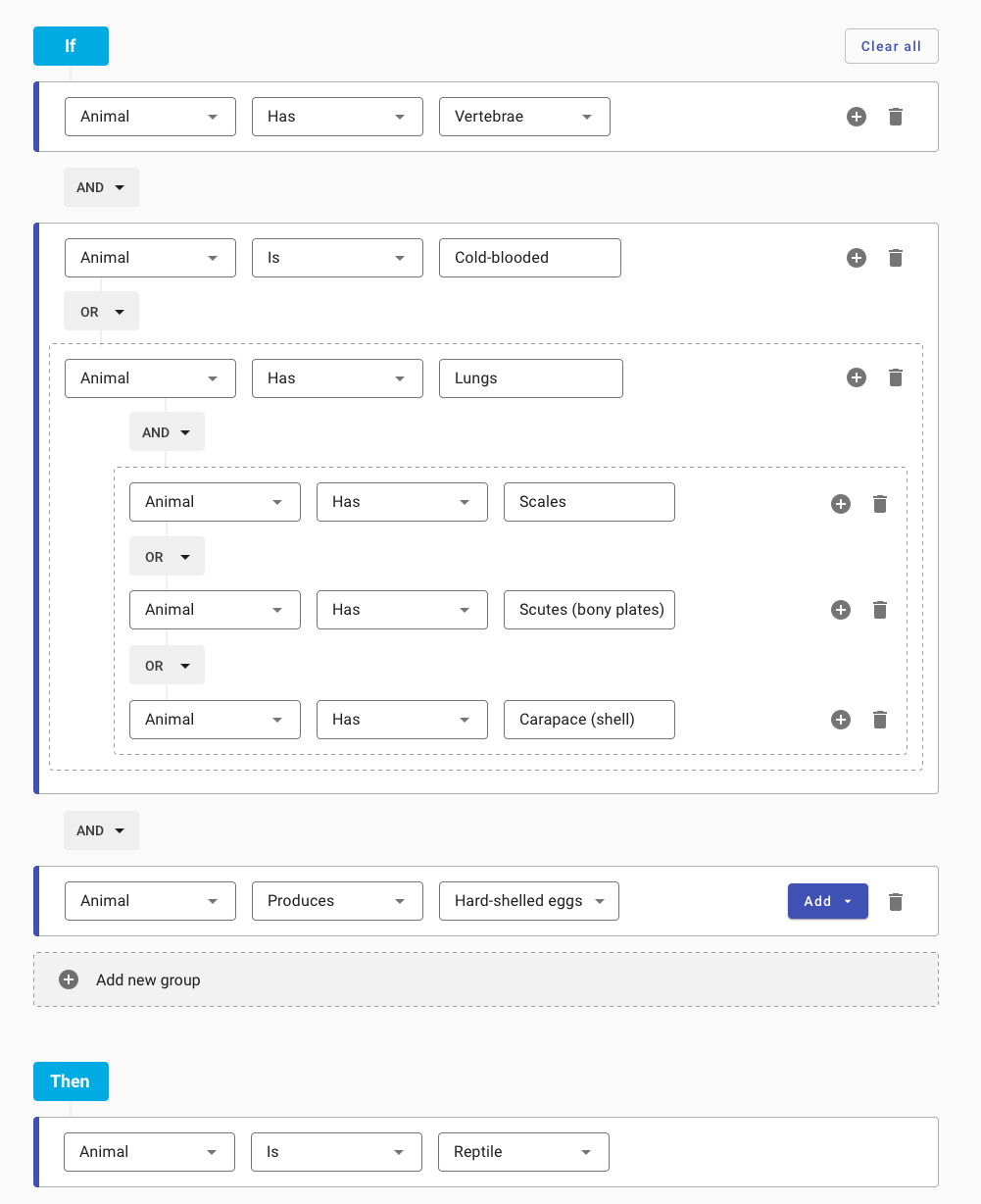
This design solution for my “Reptile Rule” is fairly close to our final solution. Once I had the interface and interactions worked out, I created a prototype with the appropriate GL content using Sketch and InVision, and shared it with the product team. A few nuances needed to be ironed out, so I then met with the Front End Developer to talk through some of the issues he saw, and we compromised on solutions.
Prototype screen of the “Reptile Rule”
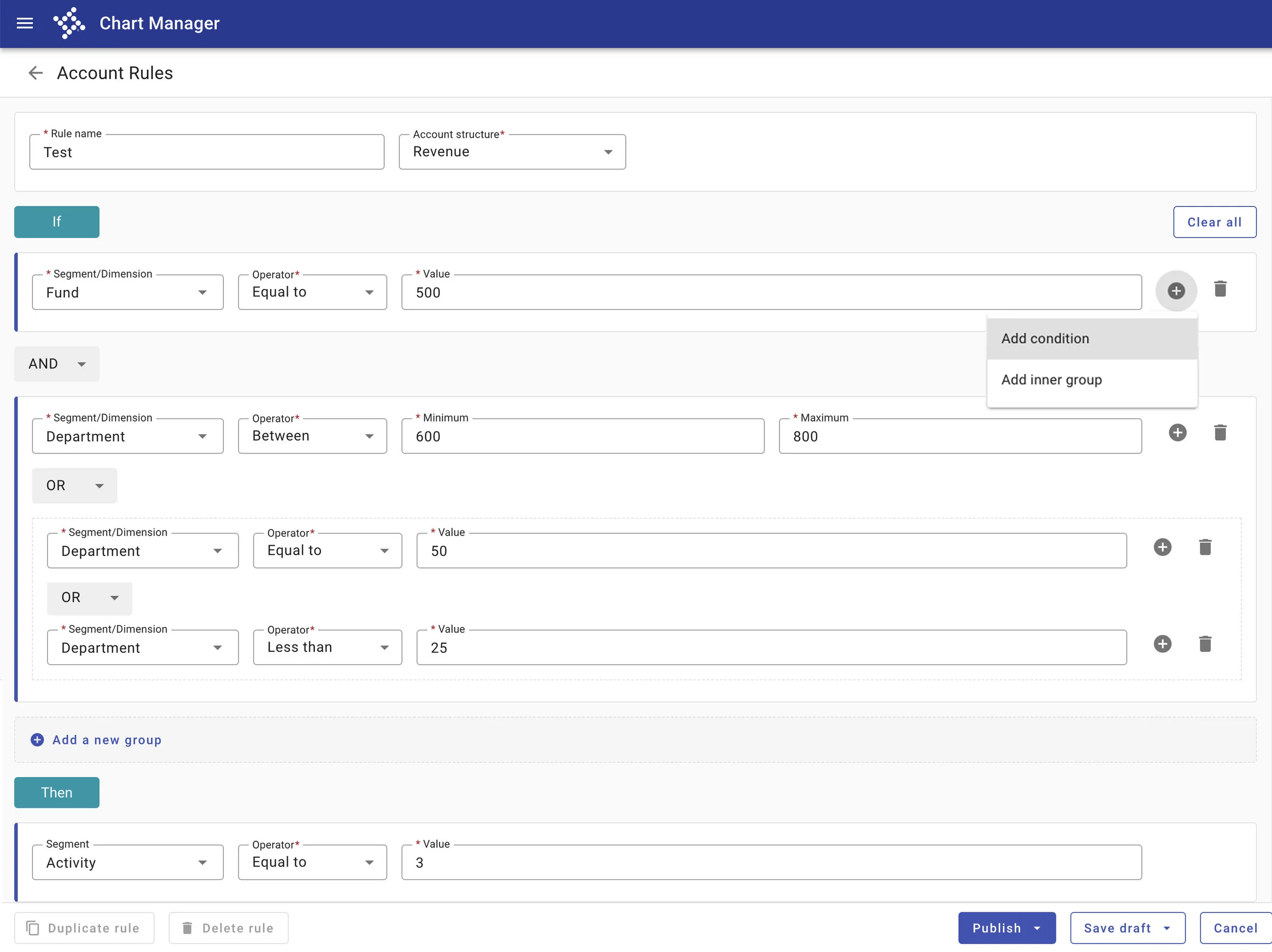
Final Account Rules Builder design
Test
Due to the complexity of this rules builder and the limitations of InVision, we decided to build out a coded prototype with real-life data in order to do our user testing. (Please see video at top).
I am fortunate enough to be working with a UX Researcher dedicated to this project. Our first round of testing was done with our own Implementation staff, and because this is a brand new feature, the testing was kept very high-level and only two tasks were given:
Task 1
Create the following account rule:
If Object Class equals 35, then Object is between 403500 and 403599
Task 2
Create the following account rule:
If Fund equals 0100 and Function equals 44, then Division is between 4400 and 4499
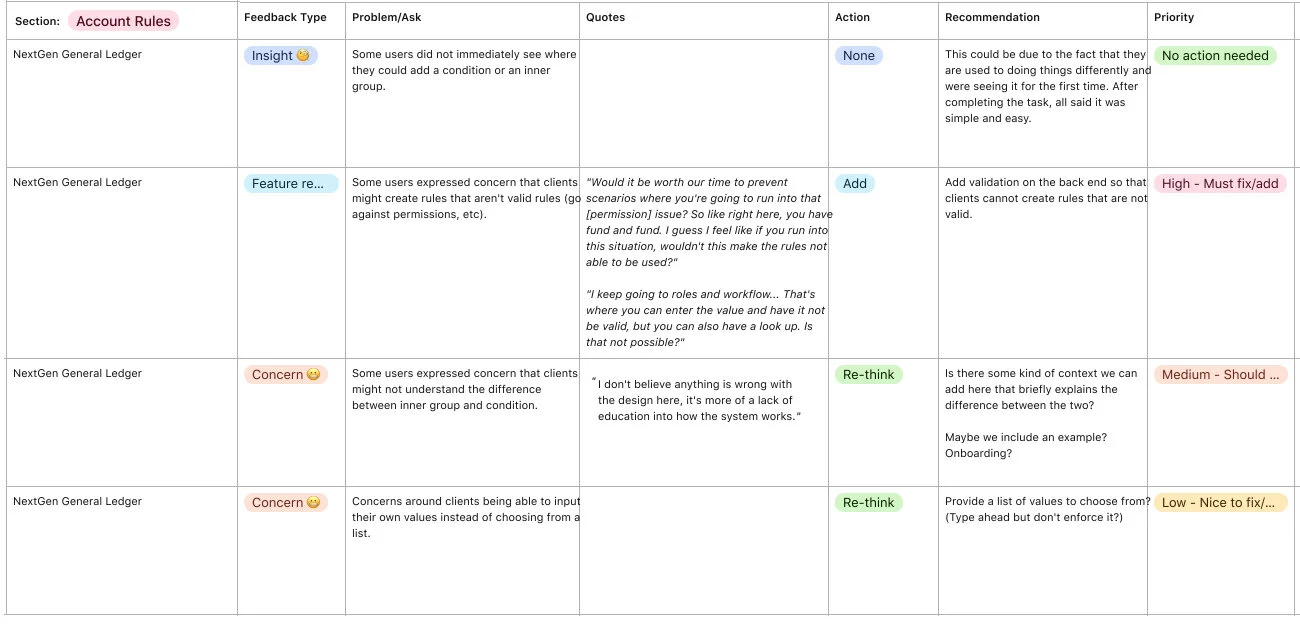
Some of the research findings from this testing session are captured below:
What’s next?
Based on this first round of testing, we’ve already made some updates. For example, the text fields now utilize type-ahead and error validation has been added on the back end. The UI has also been tightened-up by the our Front End Developer.
I should note we are aware that there will be a learning curve once this feature goes live, and our clients will need to undergo some light training. That being said, I’m looking for to seeing how this Rules Builder tests with our clients before we get there ;)
What I learned
I don’t want to be an accountant or hold any position in the realm of finance :)
But aside from that, I learned the importance of doing due diligence before diving into design. This was my first complex design challenge on the General Ledger project, and my first time working with a full product dev team. So understanding the product and the business goal(s) was essential to producing a viable concept and effectively communicating with my team. I also gained a deep appreciation for the development work that goes into our products, particularly these data-heavy back office applications.